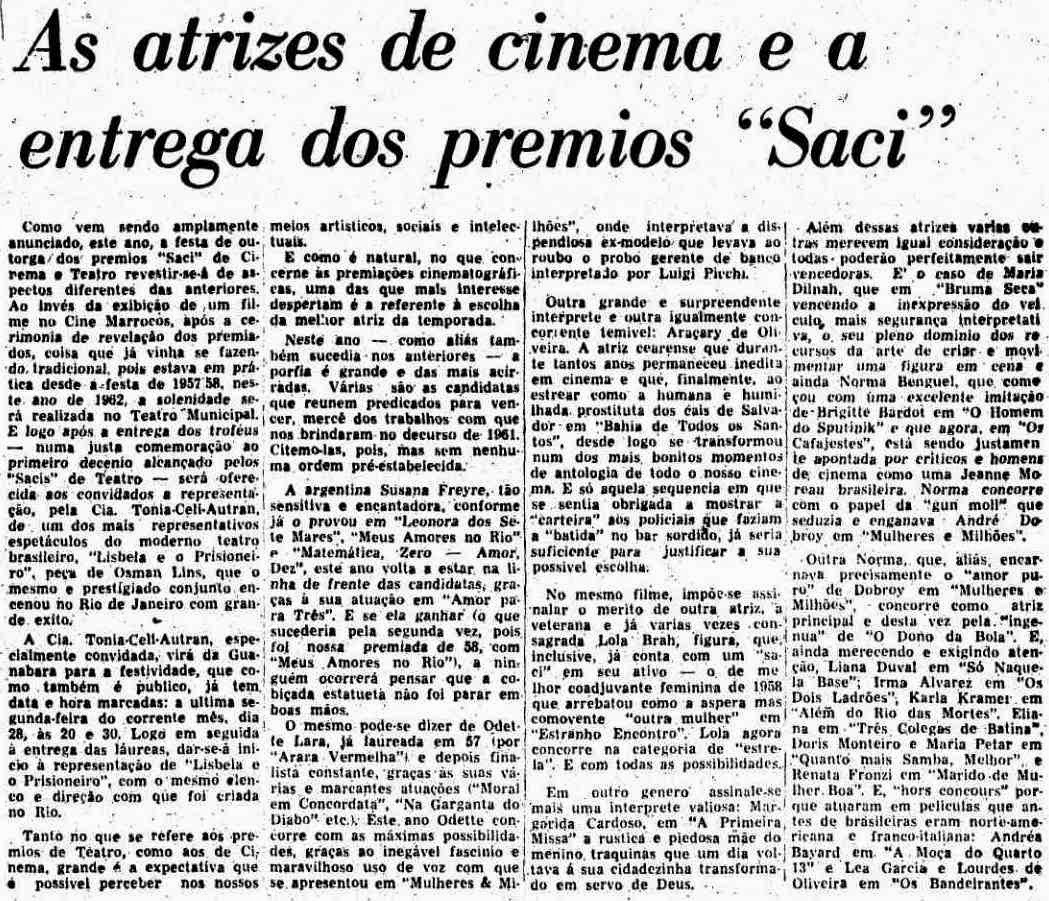
1961 is the year the most popular form of Brazilian cinema died: the musical comedy much maligned by the elitist media as 'chanchada' could not compete with the rising ubiquity of television. Television programmes could give the same recipe of comedy and musical numbers daily and the consummer did not have to leave the comfort of his own home.
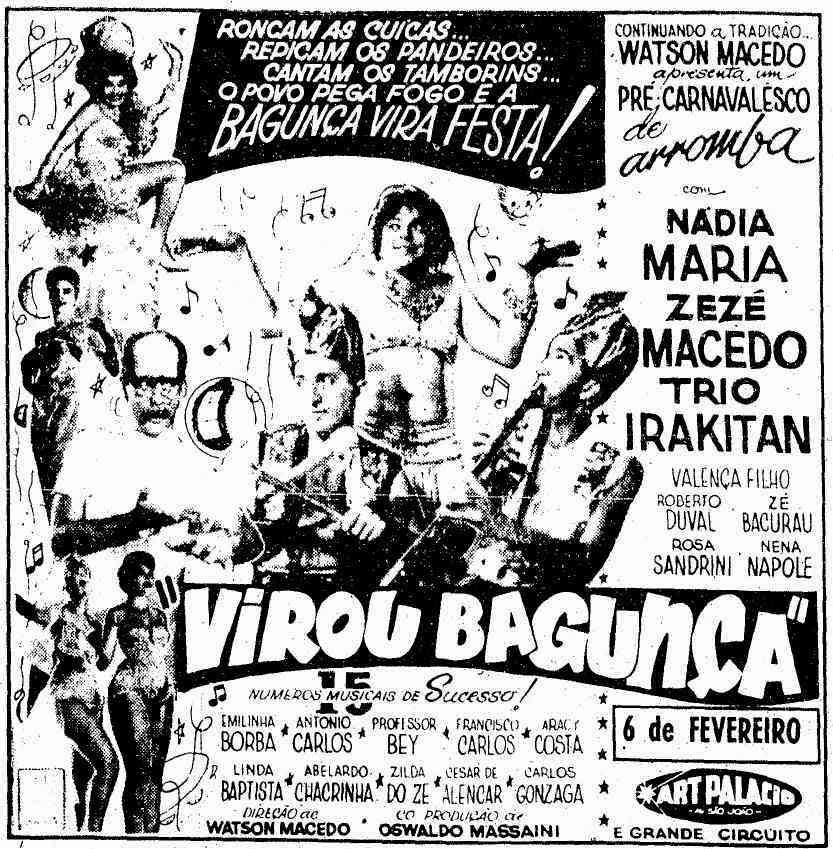
22 January 1961 - The new year starts all fine for the Brazilian cinema... that's high summer in South America just a little before Carnaval when the whole country explodes in festivity and gaiety; one can see by the titles of the movies: 'Virou bagunça' (All tuned into a mess-up) or 'O viúvo alegre' (The gay widower)... debauchery (excessive indulgence in sensual pleasures - intemperance) is the best word to explain the spirit of Carnaval and the Brazilian mind during the summer time festivities; song, dance, booze and sex... or innuendo. Maybew that's why the 'high brows' in the press hated the Brazilian popular comedy they called 'chanchada' which translates better in German - Schweinnereien (ribaldry, smut).

Releasing a Zé Trindade movie was a major PR operation as one can see by the size of the ad that takes almost half a page of the daily OESP. Zé Trindade's antics were usually panned by the major newspaper columnists but time has proved they were biased and culturally colonized. High brows disdained these comedies and dubbed them as 'chanchadas', a word derived from 'chanco' (swine) but they were hugely popular.


13 February 1961 -

26 February 1961 - OESP's columnist kept on calling comedies made in Rio de Janeiro as 'comedia carioca de costumes' (carioca situation comedies) which was pointless and only showed a backward parochialism on the part of journalists with chips on their shoulders working for conservative S.Paulo newspapers.


11 March 1961 -


15 April 1961 - Ankito & Grande Otelo in 'Um candango na Bela Cap' which is all about the building of Brasilia the new capital aka Nova Cap that was inaugurated on 21st April 1960. Rio de Janeiro the former capital was known as Bela Cap (beautiful capital).

23 April 1961 -


20 July 1961 -

24 July 1961 - J.B.Tanko's 'O dono da bola' is Ronald Golias' 2nd movie for Herbert Richers coming after 'Tudo legal' (31st October 1960).


13 August 1961 - This is probably Oscarito's last great comedy. Carlos Manga's 'Os dois ladrões' (Two thieves) has got the now-legendary scene in which Oscarito and Eva Todor ape Grouch Marx mirror scene in 'Duck soup' in 1933.
Mirror scene: in 'Duck soup' Groucho Marx's Pinky, dressed as Firefly, pretends to be Firefly's reflection in a missing mirror, matching his every move - including absurd ones that begin out of sight - to near perfection. In one particular surreal moment, the 2 men swap positions, and thus the idea of which is a reflection of the other. Eventually, and to their misfortune, Chicolini (Chico Marx), also disguised as Firefly, enters the frame and collides with both of them.
Although its appearence in 'Duck soup' is the best known instance, the concep of the mirror scene did not originate in this film. Harold Lloyd used essentially the same routine in his 1919 short 'The marathon'.
Max Linder included it in 'Seven years bad luck' (1921), where a man's servant have accidentally broken a mirror and attempts to hide the fact by imitating his actions in the mirror's frame. Charlie Chaplin used a similar joke in 'The floorwalker' (1916), though it did not involve a mirror.
 20 August 1961 - Co-production Luso-Brazilian', Armando Miranda's 'O cantor e a bailarina' premieres in Rio de Janeiro. Sao Paulo would only see it on 5 November 1961.
 20 August 1961 - Watson Macedo's last production... '3 colegas de batina' had his niece Eliana Macedo playing the heroine alongside Herval Rossano like they did in 'Samba em Brasilia' a year before... Trio Irakitan play themselves with different names...
 20 August 1961 - Dercy Gonçalves plays dona Faustina in 'Com minha sogra em Paquetá' (With my mother-in-law in Paquetá).

 28 August 1961 - Coming from TV, comedian Vagareza (Slowness) was too little too late: 'Eu sou o tal' directed by Eurides Ramos could not draw big crowds for the genre was dying fast.
 24 September 1961 - Marcel Camus returns to Brazil 3 years after 'Black Orpheus' to shoot 'Os bandeirantes'...

Mirror scene: in 'Duck soup' Groucho Marx's Pinky, dressed as Firefly, pretends to be Firefly's reflection in a missing mirror, matching his every move - including absurd ones that begin out of sight - to near perfection. In one particular surreal moment, the 2 men swap positions, and thus the idea of which is a reflection of the other. Eventually, and to their misfortune, Chicolini (Chico Marx), also disguised as Firefly, enters the frame and collides with both of them.
Although its appearence in 'Duck soup' is the best known instance, the concep of the mirror scene did not originate in this film. Harold Lloyd used essentially the same routine in his 1919 short 'The marathon'.
Max Linder included it in 'Seven years bad luck' (1921), where a man's servant have accidentally broken a mirror and attempts to hide the fact by imitating his actions in the mirror's frame. Charlie Chaplin used a similar joke in 'The floorwalker' (1916), though it did not involve a mirror.


17 September 1961 - a Brazilian-USA co-production filmed in São Paulo and São Vicente, 'A moça do quarto 13 ' (Girl in room 13)
A letter summons US detective Steve Marshall to Sao Paulo, Brazil, in search of fugitive murderess Louise Dunning. Marshall contacts Louise and learns that she murdered her husband only in self-defense. In the meantime, Marshall is set up as a pawn in a counterfeiting ring (they were the ones who had sent him the letter), and unwittingly helps the police capture the criminals. Louise decides to remain in Brazil. (synopsis written by Mark Holcomb - mholcomb@europa.com - for IMDb).
 17 September 1961 - daily OEPS's columnist praises 'Girl in room 13' saying that even though the plot line is not really original there are good quality elements in the movie like Andrea Bayard's and John Herbert's acting, Konstantin Tkaczenko's photography and Pierino Massenzi's scenography which showed S.Paulo in a better view than 20th Century Fox's Henry Levin who had filmed S.Paulo less than a year before for 'Holiday lovers'.

 8 October 1961 - Even though it is lauded as 'a Paulista film'... Jorge Ileli's 'Mulheres e milhões' was as Carioca as it could be... it premiered in Rio de Janeiro on 13 July 1961 and was box-office hit.
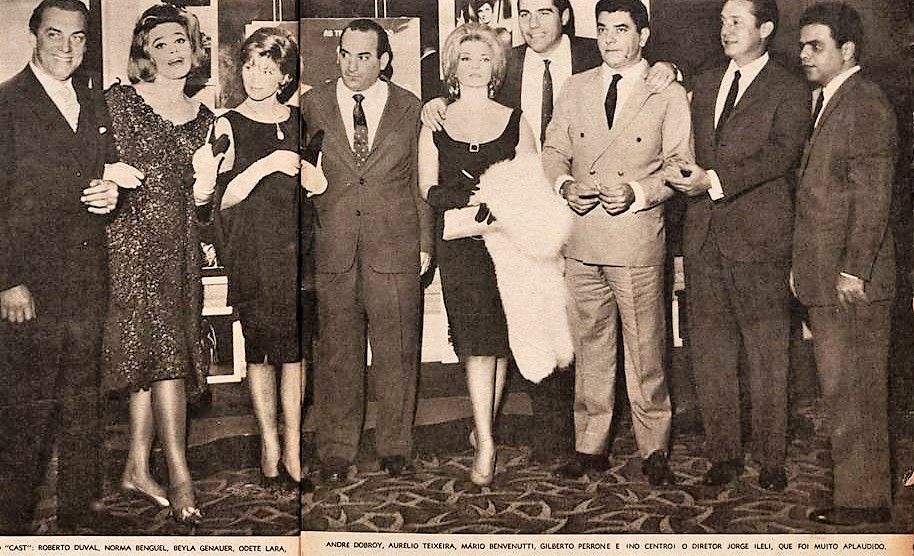
 from left to right: Roberto Duval, Norma Benguel, Beyla Genauer, director Jorge Ileli, Odete Lara, André Dobroy, Aurelio Teixeira, Mario Benvenutti and Gilberto Perrone.
 29 July 1961 - illustrated weekly magazine 'O Cruzeiro' splashes this photo of 'Mulheres & Milhões' opening night at Cine Metro in Rio de Janeiro.



 6 December 1961 - Not much information about 'Quanto mais samba melhor'. The title was obviously inspired by Billy Wilder's 1959's 'Some like it hot', 'Quanto mais quente melhor' in Portuguese. It's probably Cyll Farney's last appearance as a heart-throb. Vagareza was a comedian on the ascent but due to the genre's demise he had to make do at TV instead.

 8 December 1961 - 'Correio da Manhã' brings this ad of Victor Lima's 'Mulheres, cheguei!' which is probably Zé Trindade's last appearance as a leading comedian in a Brazilian musical-comedy which was dying fast with the rising popularity of television.


 24 December 1961 - After 2 weeks of being premiered in Rio de Janeiro 'Mulheres, cheguei' opens in São Paulo too. As we've already mentioned it is amazing how the Brazilian musical-comedy had a sudden death. It started 1961 with great fanfare and ended it with a sad note.
 17 December 1961 - Opens in Rio de Janeiro's Paris Palace 'Um pirata do outro mundo' with Simplicio, Colé & other comedians. Musical numbers done by Portuguese songster Esther de Abreu, Trio de Ouro, Rogéria, Conjunto Farroupilha and Raul de Barros & orchestra.
 24 December 1961 - Victor Lima's 'Os três cangaceiros' is perhaps the last musical-comedy to be released. Television could offer the same product and the consummer didn't have to leave home... Ronald Golias himself was one of the 1st stars that became popular through TV: this was his 3rd movie in period of one year... he had to go back to TV after it. Ankito's career was at an end... and Grande Otelo had to play 'character roles' the rest of his life. Ironically, Neyde Aparecida was also a by-product of TV.
Differently from the US cinema industry which made inroads in the production of TV movies & series, the Brazilian movie industry declined to almost extinction.




Luely Figueiró appears as a singer; Lyris Castelani as a dancer...

29 October 1961 -

5 November 1961 - a rare Portuguese-Brazilian co-production, 'O cantor e a bailarina'.


19 November 1961 - This was actually Watson Macedo's last film. Directed by Darcy Evangelista, but Macedo's name appears as 'uma realização de Watson Macedo'.


OESP columnist wrote the same nonsense about the Brazilian musical-comedy. Little did he know that with the passing of 1961, the genre would be dead and buried too.

Differently from the US cinema industry which made inroads in the production of TV movies & series, the Brazilian movie industry declined to almost extinction.

24 December 1961 - Brazilian film distribuitor Cinedistri wishes their best Season Greetings to all readers of OESP and gives a preview of what 1962 would bring: 'Eu sou o tal' with Vagareza & Nancy Wanderley; 'Três colegas de batina' with Eliana & Trio Irakitan; 'As pupilas do senhor reitor' with Anselmo Duarte & Marisa Prado; 'Sai dessa, recruta' with Ankito & Consuelo Leandro; 'A ilha' with Eva Wilma & Luigi Picchi; 'Teus olhos castanhos' with Francisco José, Aracy Cardoso & Elizabeth Gasper; 'O pagador de promessas' with Leonardo Villar & Gloria Menezes; 'A morte comanda o cangaço' with Alberto Ruschel & Aurora Duarte; 'Assassinato em Copacabana' with Mario Lago & Milton Moraes; 'Lampião, rei do cangaço' with Leonardo Vilar & Milton Ribeiro; 'A grande feira' with Luiza Maranhão, Geraldo Del Rey & Helena Ignez and finally 'A moça do quarto 13' with Brian Donlevy & Andrea Bayard.
28 December 1961 - Carlos Hugo Christensen's 'Esse Rio que eu amo' with Jardel Filho, Tonia Carrero, Odete Lara & Daniel Filho.


.PNG)
.PNG)